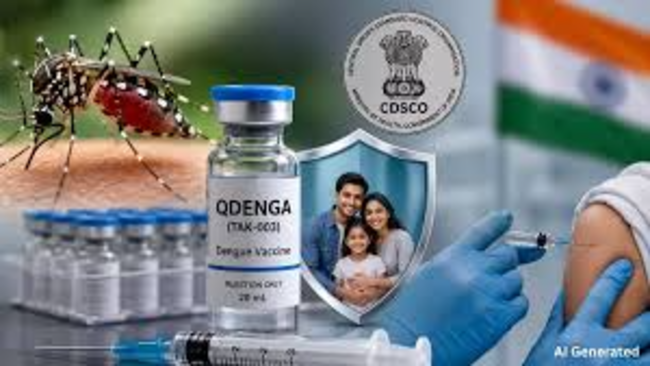
इंजेक्शन से डेंगू कंट्रोल
यह वैक्सीन 4-60 साल के लोगों के लिए मंज़ूर की गई है और इसे बिना पहले डेंगू स्क्रीनिंग के लगाया जा सकता है, जो इस बीमारी के खिलाफ भारत की पहली वैक्सीन-बेस्ड स्ट्रेटेजी है।
जापान की टेकेडा बायोफार्मास्युटिकल्स को ड्रग कंट्रोलर जनरल ऑफ़ इंडिया (DCGI) से अपनी डेंगू वैक्सीन, QDENGA के लिए मंज़ूरी मिल गई है, जिससे यह भारत में डेंगू की रोकथाम के लिए मंज़ूर होने वाली पहली वैक्सीन बन गई है।
यह वैक्सीन 4-60 साल के लोगों में इस्तेमाल के लिए मंज़ूर हो गई है और इसे पहले हुए डेंगू इन्फेक्शन की परवाह किए बिना लगाया जा सकता है, जिससे प्री-वैक्सीनेशन स्क्रीनिंग की ज़रूरत खत्म हो जाती है।
यह मंज़ूरी भारत की डेंगू कंट्रोल कोशिशों के लिए एक मील का पत्थर है, क्योंकि यह देश की पहली वैक्सीन-बेस्ड रोकथाम स्ट्रेटेजी शुरू करती है। अब तक, डेंगू की रोकथाम ज़्यादातर मच्छरों पर कंट्रोल, निगरानी और लोगों में जागरूकता पर निर्भर रही है, जबकि इलाज सिर्फ़ सपोर्टिव केयर तक ही सीमित रहा है क्योंकि इस बीमारी के लिए कोई खास एंटीवायरल थेरेपी नहीं है।
यह मंज़ूरी ऐसे समय में मिली है जब भारत में डेंगू का बोझ लगातार बढ़ रहा है। पिछले दो दशकों में डेंगू के रिपोर्ट किए गए मामले 11 गुना से ज़्यादा बढ़ गए हैं। 2025 में 113,000 से ज़्यादा डेंगू के मामले रिपोर्ट किए गए, हालांकि मॉडलिंग स्टडीज़ से पता चलता है कि असल में इन्फेक्शन की संख्या हर साल करोड़ों में हो सकती है।
QDENGA एक लाइव-एटेन्यूएटेड टेट्रावैलेंट वैक्सीन है जिसे सभी चार डेंगू वायरस सीरोटाइप से बचाने के लिए डिज़ाइन किया गया है। इसे दो-डोज़ के तौर पर दिया जाता है, जिसमें दूसरी डोज़ पहली डोज़ के तीन महीने बाद दी जाती है।
यह मंज़ूरी टेकेडा के ग्लोबल क्लिनिकल डेवलपमेंट प्रोग्राम पर आधारित है, जिसमें 19 फेज़ I, II और III क्लिनिकल ट्रायल्स में 28,000 से ज़्यादा पार्टिसिपेंट्स शामिल थे, साथ ही भारत में की गई एक फेज़ III स्टडी भी शामिल थी, जिसमें 4-60 साल के लोगों में वैक्सीन की सेफ्टी और इम्यूनोजेनिसिटी का मूल्यांकन किया गया था।
कंपनी के मुताबिक, इसके अहम फेज़ III TIDES ट्रायल में, जिसमें आठ डेंगू-इंडेमिक देशों के 20,000 से ज़्यादा पार्टिसिपेंट्स ने हिस्सा लिया, दूसरी डोज़ के एक साल बाद वायरोलॉजिकली कन्फर्म्ड डेंगू के खिलाफ 80.2 परसेंट का असर दिखा। स्टडी में 18 महीने बाद डेंगू से जुड़े हॉस्पिटलाइज़ेशन के खिलाफ 90.4 परसेंट असर और 4.5 साल में हॉस्पिटलाइज़ेशन को रोकने में 84.1 परसेंट असर भी बताया गया। टेकेडा ने कहा कि फॉलो-अप डेटा ने सात साल तक लगातार सेफ्टी और असर दिखाया है।
कंपनी ने कहा, "डेंगू एक बढ़ती हुई पब्लिक हेल्थ चुनौती है, और भारत को लगातार, सबूतों पर आधारित रोकथाम की ज़रूरत है।" उन्होंने कहा कि यह मंज़ूरी देश में डेंगू की रोकथाम को मज़बूत करने की दिशा में एक ज़रूरी कदम है।
वर्ल्ड हेल्थ ऑर्गनाइज़ेशन (WHO) QDENGA को डेंगू-इंडेमिक जगहों पर इस्तेमाल करने की सलाह देता है, जिसके लिए प्री-वैक्सीनेशन स्क्रीनिंग की ज़रूरत नहीं होती। वैक्सीन को WHO प्रीक्वालिफिकेशन भी मिला है, जिससे यह UNICEF जैसी इंटरनेशनल एजेंसियों द्वारा खरीदने के लिए एलिजिबल हो गई है।
2022 में अपने पहले अप्रूवल के बाद से, QDENGA को एशिया, लैटिन अमेरिका और यूरोप के 43 देशों में रेगुलेटरी अप्रूवल मिल चुके हैं। पब्लिक और प्राइवेट इम्यूनाइज़ेशन प्रोग्राम के ज़रिए दुनिया भर में 32 मिलियन से ज़्यादा डोज़ बांटी जा चुकी हैं। यह वैक्सीन ब्राज़ील के नेशनल इम्यूनाइज़ेशन प्रोग्राम का हिस्सा है और अर्जेंटीना, कोलंबिया और इंडोनेशिया में पब्लिक वैक्सीनेशन प्रोग्राम के ज़रिए भी उपलब्ध है।
टेकेडा को उम्मीद है कि रेगुलेटरी और सप्लाई चेन प्रोसेस पूरे होने पर, QDENGA 2027 की पहली छमाही में भारत में कमर्शियली उपलब्ध हो जाएगी।
कंपनी ने आगे कहा, "मार्केटिंग ऑथराइज़ेशन के बाद, QDENGA के भारत में कमर्शियली उपलब्ध होने से पहले कई ज़रूरी कदम उठाने होंगे, जिसमें संबंधित रेगुलेटरी अथॉरिटी से ज़रूरी रजिस्ट्रेशन सर्टिफिकेट और इंपोर्ट लाइसेंस लेना शामिल है।" उन्होंने आगे कहा कि वैक्सीन जर्मनी के सिंगेन में टेकेडा की फैसिलिटी में बनाई जाएगी, जिसके बाद हर बैच का कमर्शियली डिस्ट्रीब्यूशन से पहले सेंट्रल ड्रग्स लेबोरेटरी द्वारा ज़रूरी क्वालिटी रिव्यू किया जाएगा।
कंपनी ने यह भी कहा कि वह रोलआउट के लिए ज़रूरी बाकी रेगुलेटरी प्रोसेस को पूरा करते हुए भारत से डिमांड को पूरा करने के लिए पर्याप्त मैन्युफैक्चरिंग कैपेसिटी भी पक्का करेगी।
टेकेडा ने भारत के लिए प्राइसिंग फाइनल नहीं की है। कंपनी ने कहा, "हम वैक्सीन की वैल्यू और संभावित हेल्थ, सामाजिक और आर्थिक फायदों को दिखाने वाली कीमत पर बड़े पैमाने पर, बराबर, समय पर और टिकाऊ एक्सेस को सपोर्ट करने के लिए कमिटेड हैं। लोकल प्रोसेस पूरे होने के बाद प्राइसिंग और अवेलेबिलिटी के बारे में बताया जाएगा।"
शुरुआत में, वैक्सीन को प्राइवेट हेल्थकेयर सेटिंग्स के ज़रिए लॉन्च किए जाने की उम्मीद है। हालांकि, उन्होंने कहा कि उनका लक्ष्य समय के साथ भारत के नेशनल इम्यूनाइजेशन प्रोग्राम में शामिल करना भी है।
कंपनी ने कहा, "टेकेडा का लक्ष्य नेशनल इम्यूनाइजेशन प्रोग्राम में शामिल करके ज़्यादा से ज़्यादा योग्य लोगों तक बड़ी एक्सेस देना है। हम मानते हैं कि इसमें समय लगेगा, और पब्लिक हेल्थ चैनलों के ज़रिए बड़ी एक्सेस, हेल्थ अथॉरिटीज़ द्वारा उनके साइंटिफिक और पॉलिसी असेसमेंट के आधार पर लिए गए इंडिपेंडेंट फैसलों पर निर्भर करती है।"
टेकेडा वैक्सीन आने के बाद समय पर लोगों तक इसकी पहुँच सुनिश्चित करने के लिए प्राइवेट, स्थानीय, ट्रैवल और पब्लिक हेल्थ सेक्टर में एक साथ काम किया जा रहा है।
हेल्थकेयर एक्सपर्ट्स ने इस मंज़ूरी का स्वागत करते हुए कहा कि इससे भारत की डेंगू रोकथाम की रणनीति काफी मज़बूत हो सकती है, लेकिन उन्होंने यह भी चेतावनी दी कि वैक्सीनेशन को मौजूदा मच्छर-नियंत्रण उपायों की जगह नहीं, बल्कि उनके साथ मिलकर काम करने वाले उपाय के तौर पर देखा जाना चाहिए।
स्पर्श चिल्ड्रन्स हॉस्पिटल के फाउंडर और मुख्य पीडियाट्रिशियन सुरेश एफ. शाह ने कहा, "DCGI द्वारा QDENGA को मंज़ूरी मिलना भारत में डेंगू से निपटने के तरीके में एक बड़ा बदलाव है। अब तक, इसका मैनेजमेंट वेक्टर कंट्रोल और सपोर्टिव केयर तक ही सीमित रहा है क्योंकि हमारे पास कोई खास एंटीवायरल थेरेपी नहीं है।"
उन्होंने कहा कि वैक्सीन की डेंगू वायरस के सभी चार सीरोटाइप्स के खिलाफ इम्यूनिटी बनाने की क्षमता भारत के लिए खास तौर पर अहम है, क्योंकि यहाँ कई सीरोटाइप्स एक साथ फैलते हैं और सेकेंडरी इन्फेक्शन अक्सर गंभीर बीमारी का कारण बनते हैं।
शाह ने बताया कि इस वैक्सीन का एक मुख्य फायदा यह है कि इसे लगाने से पहले स्क्रीनिंग की ज़रूरत नहीं होती, जबकि पहले की डेंगू वैक्सीन सीरो-नेगेटिव लोगों के लिए जोखिम भरी हो सकती थीं। हालाँकि, उन्होंने यह भी कहा कि लाइव वैक्सीन होने के कारण, कमज़ोर इम्यूनिटी वाले लोगों और प्रेग्नेंसी के दौरान इसे नहीं दिया जाना चाहिए।
उन्होंने चेतावनी दी कि भले ही वैक्सीन ने बहुत अच्छा असर दिखाया है, लेकिन इससे मिलने वाली सुरक्षा पूरी तरह पक्की नहीं है और लंबे समय तक इसके असर पर अभी भी स्टडी चल रही है। उन्होंने कहा, "वैक्सीनेशन को रोकथाम के मिले-जुले उपायों का एक हिस्सा ही रहना चाहिए। यह सोर्स रिडक्शन (मच्छरों के पनपने की जगहों को खत्म करना), पर्सनल प्रोटेक्शन और चेतावनी के संकेतों - जैसे लगातार उल्टी, पेट दर्द या म्यूकोसल ब्लीडिंग - की जल्द पहचान की जगह नहीं ले सकता।"
अंजलि सिंह, साभार बिजनेस स्टैंडर्ड
QDENGA वैक्सीन: ये हैं 3 सबसे बड़ी खूबियाँ
QDENGA को बाजार में अन्य वैक्सीनों से अलग बनाने वाली तीन प्रमुख खूबियाँ इस प्रकार हैं:
चारों प्रकार के वायरस पर पूर्ण सुरक्षा (Quadrivalent Protection): डेंगू वायरस के चार अलग-अलग प्रकार (DENV-1, 2, 3 और 4) होते हैं। यह वैक्सीन शरीर में इन चारों खतरनाक वेरिएंट्स के खिलाफ मजबूत और व्यापक इम्यूनिटी (प्रतिरोधक क्षमता) का निर्माण करती है।
प्री-स्क्रीनिंग की कोई जरूरत नहीं: पहले उपलब्ध कुछ विदेशी वैक्सीनों में यह शर्त थी कि यह केवल उन लोगों को दी जा सकती थीं जिन्हें पहले डेंगू हो चुका हो। QDENGA का सबसे बड़ा लाभ यह है कि इसे किसी पुराने ब्लड टेस्ट या विस्तृत स्वास्थ्य इतिहास के आधार पर रोके बिना सीधे दिया जा सकता है।
अस्पताल में भर्ती होने का जोखिम कम: व्यापक क्लिनिकल ट्रायल्स और 7 साल के लंबे फॉलो-अप डेटा ने साबित किया है कि यह वैक्सीन सिर्फ संक्रमण को रोकने तक सीमित नहीं है, बल्कि यह मरीज के गंभीर रूप से बीमार पड़ने और अस्पताल में भर्ती होने के गंभीर जोखिम को भी काफी कम करती है।
Takeda gets DCGI approval for QDENGA, India's first dengue vaccine
The vaccine has been approved for individuals aged 4-60 years and can be administered without prior dengue screening, marking India's first vaccine-based strategy against the disease
Anjali Singh
Japan-based Takeda Biopharmaceuticals has received approval from the Drug Controller General of India (DCGI) for its dengue vaccine, QDENGA, making it the first vaccine to be approved for the prevention of dengue in India.
The vaccine has been cleared for use in individuals aged 4-60 years and can be administered irrespective of prior dengue infection, eliminating the need for pre-vaccination screening.
The approval marks a milestone for India's dengue control efforts by introducing the country's first vaccine-based prevention strategy. Until now, dengue prevention has relied largely on mosquito control, surveillance and public awareness, while treatment has been limited to supportive care as there is no specific antiviral therapy for the disease.
The clearance comes at a time when India continues to face a growing dengue burden. Reported dengue cases have increased more than 11-fold over the past two decades. More than 113,000 dengue cases were reported in 2025, although modelling studies suggest the actual number of infections could run into tens of millions annually.
QDENGA is a live-attenuated tetravalent vaccine designed to protect against all four dengue virus serotypes. It is administered as a two-dose regimen, with the second dose given three months after the first.
The approval is based on Takeda's global clinical development programme involving more than 28,000 participants across 19 Phase I, II and III clinical trials, as well as a Phase III study conducted in India that evaluated the vaccine's safety and immunogenicity in people aged 4-60 years.
According to the company, its pivotal Phase III TIDES trial, which enrolled over 20,000 participants across eight dengue-endemic countries, demonstrated an efficacy of 80.2 per cent against virologically confirmed dengue one year after the second dose. The study also reported 90.4 per cent efficacy against dengue-related hospitalisation after 18 months and 84.1 per cent efficacy in preventing hospitalisation over 4.5 years. Takeda said follow-up data have shown sustained safety and efficacy for up to seven years.
"Dengue is a growing public health challenge, and India needs sustained, evidence-based prevention," the company said. They added the approval represents an important step towards strengthening dengue prevention in the country.
The World Health Organization (WHO) recommends QDENGA for use in dengue-endemic settings without requiring pre-vaccination screening. The vaccine has also received WHO prequalification, making it eligible for procurement by international agencies such as UNICEF.
Since its first approval in 2022, QDENGA has secured regulatory approvals in 43 countries across Asia, Latin America and Europe. More than 32 million doses have been distributed globally through public and private immunisation programmes. The vaccine is part of Brazil's National Immunization Program and is also available through public vaccination programmes in Argentina, Colombia and Indonesia.
Takeda expects QDENGA to become commercially available in India during the first half of 2027, subject to completion of regulatory and supply chain processes.
"Following marketing authorization, there are several important steps before QDENGA becomes commercially available in India, including obtaining the necessary Registration Certificate and Import License from the relevant regulatory authorities," the company added. They further said that the vaccine will be manufactured at Takeda's facility in Singen, Germany, after which each batch will undergo mandatory quality review by the Central Drugs Laboratory before commercial distribution.
The company also said it will also ensure adequate manufacturing capacity to meet demand from India while completing the remaining regulatory processes required for the rollout.
Takeda has not finalised the pricing for India. "We are committed to supporting broad, equitable, timely and sustainable access at a cost that reflects the vaccine's value and potential health, societal and economic benefits. Pricing and availability will be communicated once local processes are complete," the company said.
Initially, the vaccine is expected to be launched through private healthcare settings. However, they said they also aim to secure inclusion in India's National Immunization Programme over time.
"Takeda's goal is to provide broad access to as many eligible people as possible through inclusion in National Immunization Programs. We acknowledge this will take time, and broader access, including through public health channels, depends on independent decisions by health authorities based on their scientific and policy assessments," the company said.
Takeda is working in parallel across the private, endemic, travel and public health segments to ensure timely access once the vaccine is introduced.
Healthcare experts welcomed the approval, saying it could significantly strengthen India's dengue prevention strategy but cautioned that vaccination should complement, rather than replace, existing mosquito-control measures.
"The DCGI's approval of QDENGA marks a genuine shift in how we approach dengue in India. Until now, management has been limited to vector control and supportive care because we have no specific antiviral therapy," said Suresh F. Shah, founder and lead pediatrician at Sparsh Children's Hospital.
He said the vaccine's ability to generate immunity against all four dengue virus serotypes is particularly important for India, where multiple serotypes circulate simultaneously and secondary infections are often associated with severe disease.
Shah noted that one of the vaccine's key advantages is that it can be administered without pre-vaccination screening, unlike earlier dengue vaccines that posed risks for seronegative recipients. However, he added that, as a live vaccine, it is contraindicated for immunocompromised individuals and during pregnancy.
He cautioned that while the vaccine has shown strong efficacy, protection is not absolute and long-term durability is still being studied. "Vaccination must remain one layer within integrated prevention. It does not replace source reduction, personal protection, and early recognition of warning signs such as persistent vomiting, abdominal pain or mucosal bleeding," he said.